Abu Dhabi Global Market (“ADGM”) has rolled out an updated Special Purpose Vehicle (“SPV”) application form, removing the need for applicants to provide an express nexus statement and eliminating the mandatory upload of a business plan.
Previously, applicants had to demonstrate a nexus and submit a business plan. Under the new digital application, the information previously captured through the business plan is now incorporated into structured digital fields, including the SPV’s purpose, the assets it intends to hold and the location of those assets. The Registration Authority has therefore shifted its application focus towards several key areas, including:
- Purpose disclosure – confirming the SPV will operate as a passive holding entity, not an operational business, unless a licence amendment is approved by the Registrar.
- Asset location – identifying the specific assets the SPV will hold (e.g., debt instruments, financing facilitation, aircraft, machinery, IP) and where those assets or shares are located.
- Regulatory and exemption assessment – determining whether the applicant is exempt or non-exempt under the applicable regulations, together with confirmation that the proposed incorporation complies with the ADGM Companies Regulations and subordinate rules.
The application also requires confirmation of the appointment of an ADGM-licensed Company Service Provider where applicable. For non-exempt SPVs, CSP appointment remains a continuing requirement.
The nexus question has also been removed as an express application requirement, with the Registration Authority (“RA”) confirming that the application is no longer centred on establishing a nexus to the UAE or GCC. Instead, the focus has shifted towards the SPV’s assets, where those assets are held, the applicant’s exemption status and the appropriate CSP arrangements.
This should not, however, be read as meaning that every SPV application will be accepted irrespective of its circumstances. The RA retains discretion in relation to applications, and the suitability of the proposed SPV structure, its stated purpose and the information provided to the Registration Authority remain relevant.
ADGM Simplifies SPV Applications and Shifts Focus from Nexus to Purpose and Assets
The ADGM has made a key update to its SPV application process, one that matters for international private clients, family offices, entrepreneurs and corporate groups. Following the RA’s September 2026 update, applicants are no longer required to provide an express statement demonstrating a “nexus,” to the UAE or the wider GCC as part of the SPV application. The RA has instead shifted the application focus towards the proposed SPV’s purpose, the assets it is intended to hold, the location of those assets, and the applicable exempt or non-exempt status.
This represents a meaningful change in the way ADGM assesses and processes SPV applications. It is more accurate, however, to describe the change as a shift away from an express nexus-based application requirement rather than as the complete abolition of all Registrar discretion or all considerations relating to the circumstances of an SPV.
The Previous Application Approach
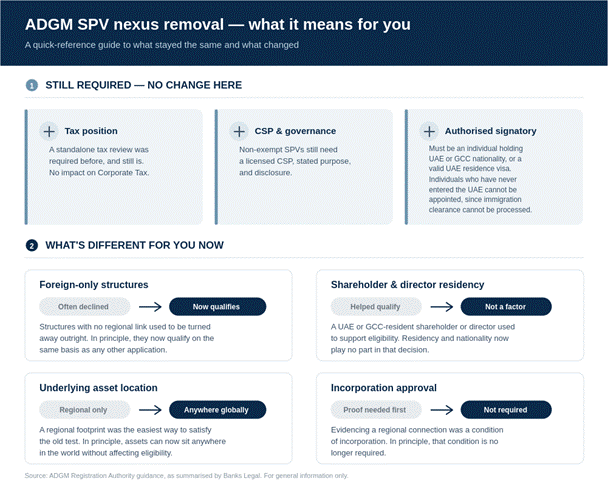
Previously, the SPV application process expressly required applicants to demonstrate an appropriate connection or “nexus” to ADGM, the UAE and/or the GCC. The previous ADGM guidance identified a number of routes through which such a connection could be demonstrated, including UAE/GCC ownership or control, UAE/GCC-based assets, transactions connected with or providing economic benefit to the UAE, and certain securities-related structures.
For example, the previous guidance indicated that an SPV wholly owned by a foreign non-resident person and holding assets entirely outside the UAE or GCC would not satisfy the stated nexus requirement.
What Has Changed
The September 2026 update materially changes the information and assessment framework for SPV applications. The RA has replaced the information previously requested through the business plan with structured digital fields covering matters such as the SPV’s purpose, intended assets and asset locations. The first stage of the application also includes a questionnaire to determine whether the applicant is exempt, non-exempt or uncertain for the purposes of the applicable CSP requirements.
Importantly, the RA explained that the “obvious question of Nexus is no longer the centre of attention”. Applicants are no longer asked to provide an express statement of nexus to the UAE or GCC. The practical emphasis has therefore moved towards understanding what the SPV is intended to hold, where the assets are located, what its purpose is and whether the applicable exemption criteria are met.
The change should therefore be understood as a shift from a predominantly nexus-focused application process towards a more structured, asset and purpose focused assessment. It does not mean that the Registrar’s discretion has disappeared or that the proposed structure is automatically acceptable irrespective of its facts.
Here is how the practical position has shifted across the areas
What This Means for Clients
For clients, this means that the absence of an obvious UAE or GCC connection should no longer, in itself, require the applicant to formulate and evidence a separate nexus statement within the SPV application. International shareholders, overseas assets and cross-border holding structures can therefore be considered within the updated application framework, subject to the proposed purpose, asset profile, applicable regulatory requirements and the Registrar’s consideration of the application.
International family offices and private clients
Families with wealth across Europe, Asia, or the Americas and no existing UAE footprint may now find the ADGM SPV application process more accessible where their proposed structure is otherwise appropriate. The absence of a UAE or GCC connection is no longer required to be expressly demonstrated through the application in the manner previously required. The suitability of the proposed holding, succession or asset-structuring arrangement will nevertheless remain relevant.
Multinational corporates
Groups using an ADGM entity as an intermediate holding company for global subsidiaries, joint ventures, or Intellectual Property (“IP”) can consider ADGM within a wider range of international structuring arrangements, without the application being centred on demonstrating a UAE or GCC nexus. The proposed assets, purpose and nature of the vehicle should nevertheless be clearly identified in the application..
Fund managers and deal structurers
SPVs used for co-investment, warehousing, or transaction-specific structuring may also benefit from the more structured application process where the proposed vehicle falls within the SPV regime and its intended purpose and assets are appropriately identified. The suitability of any particular structure remains fact-specific and should be considered alongside any applicable FSRA or other regulatory requirements..
What Has Not Changed
The focus of the application has changed, but core regulatory and compliance requirements remain. ADGM SPVs still require a clearly stated purpose at incorporation.
Non-exempt vehicles still need a licensed Company Service Provider for incorporation and ongoing administration. ADGM confirms that non-exempt SPVs must continue to appoint an ADGM-licensed CSP, and the CSP remains responsible for the relevant incorporation and ongoing statutory administration requirements.
The Registrar continues to have authority over the incorporation process, and applicants must continue to satisfy the applicable requirements under the ADGM Companies Regulations and subordinate rules. The updated application also requires confirmation of the relevant exemption status and, where applicable, CSP appointment.
The RA has also indicated that the asset information remains editable following incorporation, recognising that the purpose or asset profile of an SPV may evolve. Applicants and CSPs should therefore ensure that the information maintained on the ADGM profile remains current.
What This Means for Your Next Structuring Decision
If ADGM was previously ruled out because the structure was considered difficult to accommodate because of the previous nexus-focused application requirements, it may now be appropriate to revisit the structure in light of the updated application process.
The comparison against other holding jurisdictions can now place greater emphasis on factors such as the legal framework, cost, governance requirements, banking relationships, asset profile, tax considerations and succession objectives, alongside whether the proposed SPV is appropriate for its intended purpose.
For clients holding assets elsewhere in structures shaped around jurisdictional eligibility tests, this is a reasonable point to revisit whether ADGM now fits better than it did when the original decision was made.
The practical takeaway is that ADGM has moved away from requiring an express UAE/GCC nexus statement in the SPV application and towards a more structured assessment of the vehicle’s purpose, intended assets, asset locations and exemption status. For international structures, this broadens the range of arrangements that can be considered, while leaving the applicant responsible for demonstrating that the proposed SPV is properly structured and compliant with the applicable ADGM requirements.
Contact Details
Email: admin@bankslegal.com
WhatsApp: +971 55 655 2447